How do you deal with a hyper dog who digs at houseplants and snaps at you

November 25th, 2009 by Neil

How do you deal with an exuberant dog?  What do you do when you catch your dog “in the act”?  When is it appropriate to “discipline” your dog?  A reader writes with some great questions – and I follow up with my answers:

Thank you for your helpful blog! I have a small hound whose behavior towards other dogs is always friendly and submissive. She is generally a super friendly — and super hyper — dog.

Recently, when we have disciplined her after behavior we want to discourage (digging into our house plants) by putting her in her crate, she has resisted — first by being hard to catch, and then by actually acting aggressive and snapping at us and biting.

She needs a lot of exercise– I take her for a 2-hour walk every day — and then I play games with her to burn off some of the energy, like tug-of-war and “chase” — she loves it when she’s chased for something, so rather than something illicit, like a slipper, I’ll give her one of her toys and we’ll chase for fun. But I wonder if this is all wrong thinking on my part, and encourages the aggressive behavior when it’s time for some discipline? What is the best thing to do when she crosses the line?

Any help would be much appreciated!

I’m glad you’re finding my blog to be helpful.  For starters, here’s a post where I centralized a lot of information about aggression:  What to do when your dog is aggressive in Four Steps

That being said, there’s a LOT to cover in your e-mail.  I’ll do it as best I can quickly:

  1. Super-friendly and super-hyperthat’s good.  You have energy to work with, you just need to give her a direction for that energy that will be satisfying for her.
  2. Disciplined her to discourage behavior - I don’t recommend this at all.  At least not until you’ve given her a healthy outlet for her energy.  Once she thoroughly knows what TO do you can think about the “discipline” part – but your discipline is probably creating a charge that’s contributing towards her aggression.
  3. “by putting her in her crate”even worse! :) If anything, you want her crate to be a refuge away from the energy and stress of the human world, a little den of safety where she loves to go.  Then it becomes a convenient place for you to keep her when you need to.  Creating a negative connotation to the crate is missing out on a great opportunity to use it for something constructive.
  4. A lot of exercise – first, let me just commend you on your devotion – a two-hour walk!?!  Assuming that the walk is something you also enjoy for yourself, then how great that you’re able to take that time out during the day to get some exercise, take in the sights, etc.  However, what you’re experiencing is that while the walk might take care of the need for physical exercise, it’s not satisfying her on an emotional level.  That’s where tug can come into play – as long as you always let her win.  I have an article on how to play tug the right way here:  How to Play Tug With Your Dog
  5. Also, you do NOT want to chase her.  You want to encourage HER to chase YOU. This emphasizes your “moooseness” and teaches her, over time, that when she’s feeling energized YOU are uniquely capable of resolving it for her.  A great game to play with a high-energy dog is “Fetchtug” – and I describe how to play it here:  Fetchtug And when I say “mooseness” this is what I’m talking about:  Mooseness
  6. While it’s mentioned explicitly in some of the above articles, I want to also highlight the technique of “pushing” – which will be the cornerstone of your turning around this dynamic.  Pushing gives you a consistent way of resolving your dog’s emotional energy in a way that’s satisfying for her, and you’ll find that your dog will get calmer and calmer – instead of what it sounds like is happening now, which is that having no real outlet for her emotional energy (of which she has a lot – all “super-hyper” dogs do), she is storing that energy as stress.  Which comes out as “super”-anything, as well as misbehaving, and, ultimately, aggression.  You want her to feel COMFORTABLE and relaxed around you, even when she’s energized.  Right now you’re causing her stress and tension when she’s energized, which is manifesting as the beginnings of aggression.  How to push and Why pushing works

When do I need to use discipline with my dog?

If you get to a situation where you think that you need “discipline” – my suggestion to you is to take responsibility for the situation and think about what you could have done to prevent her getting into that predicament in the first place.  Is she being given too much “free” time without supervision?  Is she getting a healthy outlet for her emotional energy?  Did you see signs of her getting tense and energized that you ignored (instead of helping her resolve it)?  Did you miss a chance to redirect her from some mischief into something acceptable?  If you start thinking this way, I think you’ll find that the concept of “crossing the line” retreats into obsolescence.

The good news is that this work is generally easier with super-friendly, super-hyper dogs.  The “bad” news is simply that you have to just start doing the opposite of everything that you’ve been doing.  :)

Once you fix your “behavior” (and I hope you know that I’m saying all of this with a smile, not as a condemnation) – I think you’ll find that your dog’s behavior starts to take care of itself.  But I’m happy to help you along the way, of course!

Please let me know if you have any other questions.  I’ll do my best to answer them.

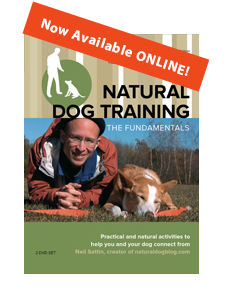
All of the techniques that I’ve mentioned to you (along with a lot more – for instance, channeling that high energy into really focused obedience) are also taught on my DVD set.  There’s a SUPER high energy hound/lab/mix dog (named Josie) on the DVDs, who’d be a great example for you.  You can check out the trailer for that here (scroll to the bottom):  Link to page about Natural Dog Training:  The Fundamentals

All my best, and please keep me posted on how it’s going.  Would you mind if I used your questions as a blog post?  I think it would be really helpful for other people to read.  I promise to keep you anonymous, of course!  And Happy Thanksgiving!

Then a GREAT follow-up from our reader:

Dear Neil –

Thank you so much for your thoughtful response! I will certainly get your CD [sic - it's a set of two DVDs] and try to learn from it also.

Just a lingering question though — for dogs to be good companions, there has to be some behaviors that are off limits. Like — nosing in our plants, munching on the dirt, and spreading it all over the floor.
To attempt dog psychology, I can see how this is all natural when she’s outside, so what’s the problem when she’s inside? It’s not hyper or aggressive behavior, just the  natural thing to do when you’re a hound and you use your nose ALL of the time (with my dog this means what goes into the nose goes into the mouth). I accept that we’ve been doing all the wrong things — but what are the right things to do in this specific instance?

Yes, of course you can use my questions as examples on your blog — and happy Thanksgiving!

Thanks again!

So what DO you do when you find your dog digging in the houseplants?

You’re most welcome, and I appreciate your willingness to get into dog mind.  Think of it as “dog heart”.

A question: how old do you think your dog is?  She sounds young, given your description.  A young dog especially needs to develop some inner structure around the question of “where do I get to deal with all this energy I’m experiencing?”

About your lingering question – and I think it gets to the root of “what drives behavior”.  You can look at “how we learn to behave” as a question of being praised for good things and punished for bad things – and hopefully we figure it out because we don’t want to be punished and we do want to be praised.  This model of psychology, however, only shows you part of what’s really going on.  And if you think of it in human terms, it’s easy to see why children raised like this might become either incredibly fearful (of making a mistake, for instance) or insecure (motivated by the desire to please others).

On the other hand, nurture what is unique in a being, nurture the part of them that yearns for, even demands expression – and THAT becomes (I believe) where their attention is focused.  For what’s at the core of our being is something good, creative, whole, and – I believe – social.  There are many speculative reasons for why dogs and humans have been linked up throughout history – but assuredly one of those reasons (which must have existed long before theories of behavior) is that a dog’s nature is somehow symbiotic with our own.  So the way that I train humans and people is meant to uncover what is simply at our core.  The closer that we are to “ourselves”, the more social and connected we can be.  For a human, that means connecting with your desire, your passion, and your presence, in the moment, on the planet.  For a dog, that means having an outlet for their emotional energy that satisfies them – and inserting you (their human) into that role.  So you can see the emotional dynamic at work within your dog in a way that’s free of human judgments.  Once you just recognize what “is”, and accept it, it frees you up to work with it, rather than fighting against it.

For the short term, you’re going to be developing a structure for your dog that reinforces, for her, that outside is where the energy moves and flows – through your interactions together.  And inside is where things are relaxed.  Massage.  Sleep.  Quiet time.  No talking, just touching.  Calming touch.  And when you’re not in a position to keep her out of the plants, she gets to go to a nice space (her crate) where’s she’s kept safe from her own curiosity.  Outside is where there’s lots to sniff, dig, and stimulate.  And the inside plants will certainly lose their appeal, as they become part of the inner landscape – just something to remind her of the relaxed state of being that being inside represents.  For that matter, if you (and whomever else is in the house) can work on keeping the indoor environment calm for yourselves (as well as your dog), it’ll cut down on the amount of stress that she feels the need to express indoors.

Let’s say, though, for the sake of your question, that you catch your dog with her nose in the plants.  What is she telling you in that moment?

“Give me something to do with my energy.”

So you could use a loud syllable (I use “Aye!”) to get her attention.  But at that point you need to give her something to DO.  Something positive.  Pull out a tug toy, let her have a tug on it and win the game.  Or grab a treat, call her name, and head off in the opposite direction so she has to come find you.

Since you’re in the house, you want to keep the play to a minimum, so once you’ve redirected her away from the plants, you might take some time to just sit with her and massage her, in order to relax her. The more relaxed your dog is, the more energy she’ll be able to experience without feeling the need to give it a voice.  When you’re in the house, the “problem” is generally one of not enough relaxation – with occasional times that you actually want to DO something to redirect energy (like when a guest arrives, or when, for whatever reason – like digging in the houseplants – she’s asking for your help).

I hope that makes sense to you!  Great question.


Want your dog to come when called, no matter what?

Want to strengthen the connection between you and your dog?

Check out Neil Sattin's Instructional Videos - step-by-step instruction that makes it easy and fun!


Related Articles


Improvisation in Dog Training and Life in General

November 20th, 2009 by Neil

One of our basic human needs is stability.  Sure we learn, and we grow – that’s happening all the time.  And it’s good to take some time to process new knowledge and skill, to feel like you really OWN the material.  But it can be all too easy to hang out in your comfort zone for too long.  When you’re training your dogs (or training yourself, for that matter), you have to honor another paradoxical need: Variety.

I’ve received several e-mails from those of you who are working with the DVD set (Natural Dog Training: The Fundamentals) that have reminded me of this issue.  The first DVD is a thorough treatment of how to do the pushing exercise, how to rechannel your dog’s energy with redirection, and how to use Tug-of-War and Fetchtug to reinforce your mooseness in your dog’s eyes – along with lots of information about the hows and whys.  I’ve been hearing stories of amazing changes in your relationship with your dog, just working on these exercises alone.  And I know that pretty much everywhere I say that the key to your success is to be gradual, be gradual.

What does it mean to be gradual in your approach to dog training?

When I talk about being gradual, what I really mean is that you shouldn’t try to do everything all at once.  That you should take your time, gaining familiarity with the techniques, owning them in your muscle memory, letting the work that you’re doing with your dog register with the way that you feel.  While the mechanics are certainly important, the new awareness of your dog’s interactions with the world and your interactions with your dog are the true nuggets of understanding that will carry you through all levels of the training.  So when I talk about being gradual, I’m talking about going easy on yourself and your dog, feeling free to take time with the material, and soaking it up into the fabric of your experience.

That being said, you should resist the temptation to give into your need for stability, which can trend towards perfectionism.  You don’t have to have everything “perfect” before you move onto the next technique.  Your dog doesn’t have to have the hardest push in the world before you start working on heeling, or sit/stay/down.  As you start to feel like you “get” what you’re doing on an intuitive level, even if you haven’t “mastered” it – that’s a sign that you should try something new.

I know, I know – I made TWO DVDs.  And one is called “The Basics” and the other one is called “Mastering Obedience”.  Surely you need to perfect every basic technique before you’re ready to master obedience, right?  Wrong!!!

Remember that “obedience” work is not separate from becoming the moose.  It is PART of becoming the moose.

When you use basic techniques to put your dog into the right emotional state, obedience behaviors flow naturally as long as you know how to elicit them.  That’s what the second DVD is all about (and the writing on this site about, for instance, box work – Sit, Down, Stay).  The DVDs also cover heeling, which so far I haven’t written about in any detail on this site.  Now that you know how to elicit your dog’s attraction, how to work WITH your dog’s emotional energy – in fact how to attract it, then you are ready to start working on the obedience techniques that I talk about here on this site and on DVD #2.

As you work through THOSE exercises they will also reinforce your mooseness, because your dog will be responding to you in a way that honors the deepest forces in their emotional makeup.  When you taught your dog to sit BEFORE they might have experienced it as an interruption of the flow, but this different way of teaching sit will actually increase your dog’s flow and attraction to you.  And since basic techniques like pushing and tug free up a lot of energy in your dog, by working on obedience you are actually reminding your dog of the best ways for them to channel their energized attraction to you.  In this context, being “obedient” actually helps resolve the energy within them.

Plus, variety really is the spice of life

In order to keep moving, to keep growing, and to keep your dog engaged in the process, you have to fill your need for variety as well.  As you learn more and more of the techniques, you will feel comfortable enough to  improvise during the time that you spend with your dog.  This improvisation will teach you how to switch fluidly, in the moment, from one technique to the next, until they just become “the way” that you interact with your dog.  At that point, you start to forget that there are “techniques” per se, and “obedience” – you just have a relationship, with all the natural give and take of any successful relationship.  You won’t get there tomorrow – and that’s what “being gradual” is all about.  But please, feel free to embark on that journey TODAY.

After all, the variety will keep things fun for both you and your dog.  And if it ain’t fun, what’s the point?  Actually, let me rephrase that.  If you can’t MAKE it fun, then what’s the point?

All my best to you and your dogs.

Zella Smiles At You

Zella Smiles At You


Want your dog to come when called, no matter what?

Want to strengthen the connection between you and your dog?

Check out Neil Sattin's Instructional Videos - step-by-step instruction that makes it easy and fun!


Related Articles