“Be The Moose” Is a More Compelling Metaphor

October 14th, 2009 by Neil

There’s a discussion raging at DogStarDaily, in a response to one of Lee Charles Kelley’s blog posts over at Psychology Today (warning – you’ll find dog trainers with raised hackles if you follow those links).  In LCK’s post, he’s wondering why the Operant Conditioning-ers seem to be losing the “battle” (at least the publicity battle) to the Alpha Theory-ers.  In other words, why is Cesar Milan so gosh darn popular, when people who base their methods explicitly on Learning Theory and Behaviorism should achieve such astounding results as to render Cesar omega’d?  For that matter, why do people in the training community talk about being your dog’s leader even though all that matters is how you combine the “four quadrants” (and, of course, classical conditioning – and, of course, “the specifics of canine behavior”) to get the behaviors you want in your dog?

The author at the DogStarDaily, Eric Goebelbecker, points out that “Alpha” methods of training, whether they work or not, are still using the scientific principles of learning theory (whether Cesar Milan knows it or not).  The mixed success of “Alpha” trainers, then, is the result of “it works when you’re unintentionally applying the methods of learning theory” and “it doesn’t work when you unintentionally don’t apply the methods of learning theory.”

The same could be said for the positive/clicker/operant conditioning/behaviorist/etc. trainers who are out there.  When they fail, it’s just because, in the words of one of the commenters on LCK’s post (who was quoting Bob Bailey, a well-known behaviorist) “80% of the problems he sees in training have to do with behavior criteria, rate of reinforcement, and timing of the reward marker.”  In other words – you succeed when you apply learning theory correctly, and you fail when you don’t.

In dog training and elsewhere, the metaphor holds the power

But the reason that trainers talk about being “the leader”, or why Cesar Milan has built himself an empire, is that, in general, we humans are attracted to metaphors that make sense.  It doesn’t mean that the metaphor is always right – but simply that it offers something that appeals to more than our intellect.  In activating our imagination and our emotions, the metaphor gives life to theories, and gives us a frame of reference when we’re actually trying to adapt theory to practice.  It’s easier for someone to imagine themselves as the idealized “alpha dog” dominating the rest of the pack than it is for them to sit down and make charts analyzing their rate of reinforcement.

Now if you read this blog regularly (thanks for that, btw), then you know that I’ve never made it my mission to try and prove anything “scientifically” about Natural Dog Training – nor have I engaged in debates about who “is right” in the training world.  After all, I came to Natural Dog Training because I had an aggressive dog, and no other trainers (and no amount of reading training manuals on my own) seemed to be able to help her.  But when I learned how to “Be The Moose” in my dog’s life,  she transformed.  For me, becoming the moose was a better metaphor.

Be a better metaphor – be the moose

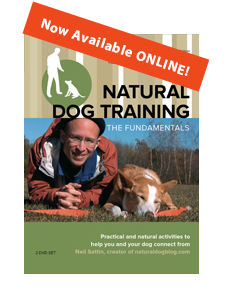
The feedback that I get from readers and clients (or from people who are using my instructional DVDs), is that generally they find “The Moose” to be a more compelling way to look at things – better for them than the “alpha” or the “leader”.  It certainly turns the conventional approach to how you imagine your influence over your dog’s behavior on its head.  Most importantly, it does that through giving us a new metaphorical frame of reference, a new way of engaging your imagination and your emotion.  The more moose-like you become, the more your dog becomes magnetized to your presence, and the more the new metaphor makes sense to you in practice.  Then the results reinforce the metaphor (R+ for the human).

Now Kevin Behan has a whole new theory for why it all works.  He would say that his “energy theory of behavior” explains why learning theory is successful (and why it fails if/when it fails).  Now I happen to really like the model.  It makes sense to me – not just on the level of dog behavior, but also on the level of human behavior.  I’ve had clients who REALLY buy into the model – and who are successful.  I’ve had clients who don’t really care about the model – but who buy into the metaphor – and they too are successful.

If you can be the moose, you can be successful

In other words, if you can wrap your brain around “the moose” being the one in control, if you can wrap your brain around obedience behaviors being hunting behaviors in a different context, if you can wrap your brain around dogs needing an object of attraction (the moose)  to vent the energy that they experience in the world – then you will get results.  With “opportunity dogs“, if you can accept that problem behavior is the result of too much tension getting in the way of releasing that excess energy with the moose, then you will get results.  The metaphor holds the power.  And the ability to get results, to have a happy dog who responds when it counts – that’s all that matters no matter what your metaphor is.

I thought I’d leave you with this photo of a friend of mine who took the metaphor to heart and decided to try “pushing” with his fiancee, who apparently REALLY loves Raisin Bran.  See, it’s all in good fun.  And now his fiancee comes whenever he calls, no matter how energized the situation.

his come hither look


Want your dog to come when called, no matter what?

Want to strengthen the connection between you and your dog?

Check out Neil Sattin's Instructional Videos - step-by-step instruction that makes it easy and fun!


Related Articles


Dog Training and Mindfulness – an Essay in The Messenger

October 12th, 2009 by Neil

The way that you train your dog is simply a component of a well-balanced life.  It’s a subject that I’ve touched on occasionally here on the Naturaldogblog, although I’ve been pretty focused on giving you some practical techniques to use with your dog.  Ultimately, however, your success with your dog is bound inextricably with your “self-success” – how well you are able to get into the moment with your dog, and be present for whatever is happening then and there.

I recently wrote an article about this topic entitled What Your Dog Can Teach You About Mindfulness, and it was published by The Messenger (follow the link to check it out).  When I talk about “success” with your dog I do mean, of course, having a dog that responds to you when it counts.  But I’m also talking about an inner success, which I measure by the degree of happiness and flow that you experience in your daily life.  That deep kind of fulfillment comes from getting closer and closer to experiences of flow and being in the moment.  Your process of getting centered, as a human, will build your relationship with your dog.  And your work with your dog will also help you achieve that presence in other areas of your life.

So what do you think?  As you work with your dog, influenced by Natural Dog Training, have you found “flow” experiences to be more common, either with your dog or in other areas of your life?  Is pushing, or box-work, or a game of tug a way for you to get centered and present?


Want your dog to come when called, no matter what?

Want to strengthen the connection between you and your dog?

Check out Neil Sattin's Instructional Videos - step-by-step instruction that makes it easy and fun!


Related Articles

  • No related posts