
In our last post, we discussed "pushing", which is one of the fundamental techniques of natural dog training. I described in detail HOW to push, taking you step-by-step through a very gradual process of introducing yourself, and your dog, to the technique. The goal of pushing is to get your dog to be attracted to you unconditionally - especially in moments of high energy and stress. In this article, we're going to describe why pushing is helpful, and how it will transform your dog's emotional responses to the world into something over which you have direct influence. Make sure that you don't skip the end, because that's where you'll find out the MOST IMPORTANT part about what pushing is accomplishing in the relationship between you and your dog - answering your dog's question of "what do I do with my energy?".
When you practice pushing, you are plugging into your dog's primal circuit - one of the first things about the world that they learned. Imagine your dog as a puppy, trying to make sense of the world. The puppy experiences the world in the most basic of ways - through its mama. There's mama's head/face, with its big eyes, sharp teeth, and the capacity for doling out discipline when the pup gets out of line. Contrast that with the warm, soft belly, the sustenance and nourishment of mama's milk and the feeling of satiation that it provides. This dynamic teaches our dog something fundamental about the way the world works - prey and predator.
Essentially:
- Head/big eyes/big teeth/etc. = predator - something that stirs up feeling but repels the pup.
- Belly/warmth/softness/sustenance = prey - something that resolves feeling and attracts the pup.
So when our dogs are out an about and feeling the world, it is the "predator" nature of things in the world that stirs them up/gets their juices flowing. However, the "prey" elements of the world allow our dogs to resolve that energized state - and ultimately it is the GOOD FEELING of that resolution that defines how our dogs act in these energized moments. In this article on being the moose in your dog's life we talked about how we humans are actually primarily predators in our dogs' life (especially if we're always focused on being the "alpha" dog in our pack) - and how the focus of natural dog training is to make us more prey-like, more moose-like - essentially the most attractive thing to our dogs in their world.
Since our dogs primary experience of us is as predators, it automatically puts them into conflict (with us) whenever they are around us in moments of high energy. Unless we can become more prey-like, we can't resolve that energy for them in a way that provides them with 100% satisfaction. That's where the pushing comes in.
So when we practice pushing with our dogs, that elicits the emotional memory in our dogs of that initial imprinting that takes place with mama. Here we are, the big, scary human, and yet we offer them the tastiest morsels of food imaginable. Our predator-ness gets the juices flowing, and the tasty treats offers them a clear path to resolving that stirred up emotional energy.
OK, so that makes sense (right?). But why "pushing"? What does the physical contact and the push add to our dog's experience? Why not just always offer them the tastiest of treats - isn't that enough to teach them that we're the biggest moose on the block?
Let's put this into human terms for the moment. Imagine that you want ten thousand dollars (that shouldn't be too difficult 🙂 ). If you're starting from zero, it might take a LOT of effort to get to that first $10,000. However, it might be substantially easier for you to get the next $10,000. In fact, after a few times, what initially seemed like an enormous sum now starts to seem like small potatoes. You might desire a larger sum of money, and find ways of obtaining it, since the $10,000 increment is less enticing and satisfying than it initially was.
So at first, the $10,000 would be like the "moose" in your life. After it becomes easy to get to $10,000, however, that sum becomes more like a "squirrel" - it requires less and less effort to get, and so getting it becomes - while still desirable - less and less satisfying. We go out looking for other mooses.
Pushing allows us to raise the stakes for our dogs. It's giving the dog two primary experiences.
- The more that your dog pushes before getting the tasty food, the more satisfied they will be when they get the food. Part of what makes the moose so appealing, remember, is that it takes mobilization of all a dog's internal energy in order to get the moose - the final feeling of exhaustion/satiation is 100% satisfying. So as you increase the actual physical effort required on the part of your dog to get the food, you will also be increasing the satisfaction that they feel when they finally get the food.
- The more that your dog pushes, the more of their energy they are SAFELY mobilizing and directing AT YOU. We are essentially establishing a new emotional response within our dogs - so that when they are energized they feel comfortable giving us 100% of that energy. This reconditioning can be tough to do given our predator-ness - if you throw in a bunch of alpha-dog-discipline meant to inhibit our dog's natural impulses then you might see how much "baggage" there can be in trying to overcome the degree of uncomfortability that our dogs feel when they're energized around us. So we start small, just feeding our dog by hand (which begins to energize them). We move on to subtle massage, helping our dog relax and getting them used to making contact with us as their level of energy rises. Then we start pushing. The more that we push, the more that they have to push back, and the more that their energy level increases - with the safe and satisfying resolution of tasty treats. Over time our dogs learn that they can safely give us as much as they are able to give - measured by the amount of energy that they direct at you with their pushing.
OK - so now for the most important part:
By creating this new emotional pathway for your dog, you are actually inserting yourself into that primal circuit that I mentioned earlier. Your dog learns that YOU offer them the best possible resolution WHENEVER they feel energized. In order to achieve this goal, you have to get to the point where they are really offering you alot of their energy in the push - and by then you will have created a very strong emotional memory/response in your dog. It'll go something like this:
- Dog starts to feel energized.
- Dog's emotional memory kicks in, recognizing (on the level of feeling - not on an intellectual level) that interacting with you brings them total satisfaction at this level of emotional intensity.
- Dog is ATTRACTED to you - and looks to you for an "answer" to the question "what do I do with all this energy?"
- You allow them to resolve the energy, staying relaxed and in the flow, and the imprint gets even deeper.
Once you can reliably get your dog energized and attract them in their energized state, you will be able to translate this attraction into obedience behaviors. In future articles, we will address how to train your dog in this state of high drive/flow, and you will see how your dog's focus actually increases as their level of energy also increases. In the meantime, keep practicing the pushing, and start paying even closer attention to your dog. The next time you encounter a squirrel on your walk through the park, your dog might just look to you for an idea of what to do. If you're prepared, and push with your dog in that moment, you've given them an answer that's infinitely more satisfying than "try to get that squirrel".
Soon we will talk more in-depth about techniques for using pushing to redirect your dog in day-to-day life.
As always - if you have any questions, feel free to leave them in the comments, or e-mail me (neil at naturaldogblog dot com). Thanks for stopping by. I leave you with this photo of part of our family at rest in the backyard on a recent summer's day. I know, I could really stand to do some mowing - but that tall grass is just so comfortable!
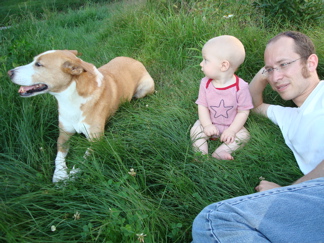



The sideburns are shorter, but he looks just like you.
This posting answered all my questions. I've got a freezer full of lamb liver, time to get started.
I've got my hair trimmed now (even the sideburns), so the resemblance is even more apparent. I look forward to hearing how it goes!
Neil, Would you please comment on pushing vs. dogs that lean in to take space and whether you think teaching pushing confuses any sort of understanding of space that dog has. Was that too vague?
Hi Angelique,
It would help me for you to clarify what you mean by the "understanding of space" in dog world - then I can talk a little bit more about how I see "space" - I just want to make sure we're talking about the same thing.
In general, I've found that teaching dogs a behavior and the context for that behavior diminishes the behavior in other situations. So in pushing - yes, by all means we are encouraging our dogs to make contact with us, contact that's directed explicitly at us. The contact becomes another positive reinforcer - something that our dogs desire as much as they might desire the food.
I'm often asked something along the lines of "so, am I teaching my dog to jump up on people?"
The answer to that question is "no" - but we are, in a way, teaching the dog to drive towards US (i.e. not the generalized "people" but the specific "us") in a manner that might resemble, to the casual observer, "jumping up on me". But that's only because the dog's front paws are in the air - a result of how much they're pushing at you - which is REALLY what's going on.
Since I brought it up (though probably should post about it separately) - I do teach dogs to jump up on command - just like I teach the "off" command. This would be another example of how it's easier to teach a behavior in a particular context ("jump up on me when I ask you to jump up on me") - which makes that behavior much less likely to happen randomly (dogs don't jump on strangers anymore, unless that stranger happens to give the "jump up on me" command).
But now I'm just rambling. If you'd like to articulate some specific points on "space" that you'd like to see addressed, I'd be happy to talk about them separately. Thanks!
I'm still new to this web site so I may have missed the info in another blog but my question follows...
This blog describes the pushing activity with food as the reward. Is the ultimate goal to get a dog into the pushing game for the release it provides itself (and not the food)? For example, if I use this technique when at an appropriate moment on a walk with my dog and I do not have food in hand, does the pushing game itself provide the release/outlet it is described to provide in the blog? Or is the food reward an essential component?
Thanks for clarifying!
Hi Amanda,
Thanks for your question. The ULTIMATE goal is for your dog to feel safe interacting with you at higher and higher levels of energy. So when your dog is energized by something in the world, you dog will be attracted to you - knowing that you can show them "what to do" with their energy. Pushing is an avenue to reaching that goal with your dog.
As for the actual pushing - in my experience "contact" can be a reward in and of itself, but usually when I'm actually "pushing" I am using food or a tug toy as the incentive to push.
If you're out on a walk and use the technique without food or a tug toy, then when you call "ready!" - followed by your dog's name - and your dog comes your way - I would suggest running in the opposite direction, i.e. getting your dog to chase you. As your dog chases you, you can still be pushing your dog - but the chase will help amplify your dog's attraction to you even without food or a tug toy present.
As you progress into the obedience work - particularly heeling - you'll find that to be a great way to channel the energy - i.e. into heeling, instead of necessarily having to push all the time.
btw - your DVDs are en route - please keep me posted!