Change yourself to change your dog

December 14th, 2009 by Neil

The key to changing your dog’s behavior is changing your own behavior.  Your success in developing the kind of relationship that you want with your dog, or changing your dog’s habits, is directly proportional to your ability to change your own habits.  In other words, if you want different results than what you’re currently experiencing with your dog, then you are going to have to start acting differently yourself.  And habits are tough to break.

The NaturalDogBlog is full of techniques that will help you learn a new way of interacting, not only with your dog, but also with the world as a whole.  Sometimes you can simply apply one of the techniques and start seeing change immediately.  It is perfectly normal, though, for the real results to be visibile after incorporating the techniques into the way that you interact with your dog on a daily basis.  So you will need to develop some new habits of behavior, and get rid of some of the old ones, in order for things to fully click into place.

Now any new habit takes time and patience to develop.  Undoubtedly your current habits exist because on some level they actually serve you.  Even habits that cause problems for you are still fulfilling some of your needs.  It’s up to you to eventually recognize that you have a choice about how your needs are met.  The needs don’t go away – they’re basic to all of us.  But, if you’re willing to take a risk, you can choose a more positive, empowering way to satisfy them.

Don’t worry – I’m here to help you figure out how to do it!

We’ll be talking more about strategies for facilitating your own change here on the Naturaldogblog.  Start by asking yourself these questions:

  • How are my habits holding me back?
  • As I read about (or watch) this new way of interacting with my dog, as I learn about how my dog feels the world, what within me is resisting accepting this information?
  • Is there a part of me that is afraid of changing my behavior?  What am I afraid of?

These questions may or may not be transformative in and of themselves, but they will certainly help you get closer to the root of what’s keeping you from making the kind of progress with your dog that you’d like to be making.  As you get closer to acting from your center, to courageously taking on your old habits, to having some clarity in your own life, your inner changes will be reflected in outer changes that you see in your dog’s behavior, and your relationship with your dog.

Change is possible, in yourself and in your dog.

My goal is to help you get there.

If you’d like to connect with others who are trying out these techniques and confronting their old habits, how about joining the discussion in the NaturalDogBlog forum?  You can discuss this article, get your own questions answered, or give feedback to others who might be wrestling with problems you’ve already solved.


Want your dog to come when called, no matter what?

Want to strengthen the connection between you and your dog?

Check out Neil Sattin's Instructional Videos - step-by-step instruction that makes it easy and fun!


Related Articles


Improvisation in Dog Training and Life in General

November 20th, 2009 by Neil

One of our basic human needs is stability.  Sure we learn, and we grow – that’s happening all the time.  And it’s good to take some time to process new knowledge and skill, to feel like you really OWN the material.  But it can be all too easy to hang out in your comfort zone for too long.  When you’re training your dogs (or training yourself, for that matter), you have to honor another paradoxical need: Variety.

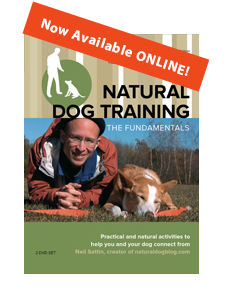
I’ve received several e-mails from those of you who are working with the DVD set (Natural Dog Training: The Fundamentals) that have reminded me of this issue.  The first DVD is a thorough treatment of how to do the pushing exercise, how to rechannel your dog’s energy with redirection, and how to use Tug-of-War and Fetchtug to reinforce your mooseness in your dog’s eyes – along with lots of information about the hows and whys.  I’ve been hearing stories of amazing changes in your relationship with your dog, just working on these exercises alone.  And I know that pretty much everywhere I say that the key to your success is to be gradual, be gradual.

What does it mean to be gradual in your approach to dog training?

When I talk about being gradual, what I really mean is that you shouldn’t try to do everything all at once.  That you should take your time, gaining familiarity with the techniques, owning them in your muscle memory, letting the work that you’re doing with your dog register with the way that you feel.  While the mechanics are certainly important, the new awareness of your dog’s interactions with the world and your interactions with your dog are the true nuggets of understanding that will carry you through all levels of the training.  So when I talk about being gradual, I’m talking about going easy on yourself and your dog, feeling free to take time with the material, and soaking it up into the fabric of your experience.

That being said, you should resist the temptation to give into your need for stability, which can trend towards perfectionism.  You don’t have to have everything “perfect” before you move onto the next technique.  Your dog doesn’t have to have the hardest push in the world before you start working on heeling, or sit/stay/down.  As you start to feel like you “get” what you’re doing on an intuitive level, even if you haven’t “mastered” it – that’s a sign that you should try something new.

I know, I know – I made TWO DVDs.  And one is called “The Basics” and the other one is called “Mastering Obedience”.  Surely you need to perfect every basic technique before you’re ready to master obedience, right?  Wrong!!!

Remember that “obedience” work is not separate from becoming the moose.  It is PART of becoming the moose.

When you use basic techniques to put your dog into the right emotional state, obedience behaviors flow naturally as long as you know how to elicit them.  That’s what the second DVD is all about (and the writing on this site about, for instance, box work – Sit, Down, Stay).  The DVDs also cover heeling, which so far I haven’t written about in any detail on this site.  Now that you know how to elicit your dog’s attraction, how to work WITH your dog’s emotional energy – in fact how to attract it, then you are ready to start working on the obedience techniques that I talk about here on this site and on DVD #2.

As you work through THOSE exercises they will also reinforce your mooseness, because your dog will be responding to you in a way that honors the deepest forces in their emotional makeup.  When you taught your dog to sit BEFORE they might have experienced it as an interruption of the flow, but this different way of teaching sit will actually increase your dog’s flow and attraction to you.  And since basic techniques like pushing and tug free up a lot of energy in your dog, by working on obedience you are actually reminding your dog of the best ways for them to channel their energized attraction to you.  In this context, being “obedient” actually helps resolve the energy within them.

Plus, variety really is the spice of life

In order to keep moving, to keep growing, and to keep your dog engaged in the process, you have to fill your need for variety as well.  As you learn more and more of the techniques, you will feel comfortable enough to  improvise during the time that you spend with your dog.  This improvisation will teach you how to switch fluidly, in the moment, from one technique to the next, until they just become “the way” that you interact with your dog.  At that point, you start to forget that there are “techniques” per se, and “obedience” – you just have a relationship, with all the natural give and take of any successful relationship.  You won’t get there tomorrow – and that’s what “being gradual” is all about.  But please, feel free to embark on that journey TODAY.

After all, the variety will keep things fun for both you and your dog.  And if it ain’t fun, what’s the point?  Actually, let me rephrase that.  If you can’t MAKE it fun, then what’s the point?

All my best to you and your dogs.

Zella Smiles At You

Zella Smiles At You


Want your dog to come when called, no matter what?

Want to strengthen the connection between you and your dog?

Check out Neil Sattin's Instructional Videos - step-by-step instruction that makes it easy and fun!


Related Articles