How to Improve Your Human Relationships Using Natural Dog Training

June 10th, 2010 by Neil

If you’ve read more than a couple articles here on the Natural Dog Blog, then you know that the way that I work with dogs has also had a profound effect on my relationships with people.  In fact, along with coaching people with their dogs, I have been coaching people to improve their relationships, and I have also been studying Strategic Intervention with Cloe Madanes, one of the world’s leading family therapists.  So when the following question arrived in my inbox I thought you might be interested in the answer:

Just read your fantastic, and thorough article which helped define calm-assertive energy for me. I need to learn how to “be the moose” with my dog, AND with my husband. I tend to go into prey energy with the husband, who is very alpha-male-executive. Then I get mad and pop up into predator/angry parent mode.

Do you have any advice for how to stay moose-like with people?!

How can I use Natural Dog Training in my relationship with my spouse?

Now for all I know this question was asked purely in jest, but the truth is that there are some great parallels that I think will really help you wrap your significant other around your finger (or simply enjoy a more dynamic relationship with others).  I’m going to give you a few general principles that can have a huge impact on your connection with other people.

Neil And Tonya Sattin

First principle:  Meet the other person’s needs in a way that is satisfying to them.

In the Natural Dog Training world, we say that a dog’s most important question is “What do I do with my energy?”  We know that for a dog the most satisfying thing to do with their emotional energy is to release it in a way that honors their prey drive.

So for the person in your life whom you’re trying to influence, ask yourself: What is this person’s most important question?  How does this person like to meet their most basic needs, for certainty, variety, significance, love, growth, and contribution?  Now think of ways that you can take charge of meeting that person’s needs.  Meet 3 or more of them at a high level, and that person will literally become addicted to you.  And follow you around like a puppy dog. :)

Second Principle: Build a person’s attraction to you through helping them overcome resistance.

In Natural Dog Training, we reinforce our dog’s attraction to us through pushing and tug-of-war.

Those exercises teach a dog how to give us their energy, particularly in emotionally charged moments.  In other words, it teaches them to keep communicating with us even when things get intense.  Sounds like the kind of thing you’d want from your partner, doesn’t it?

With dogs, we make it happen by enticing a dog with tasty food (or, in tug, a license to bite), and then providing resistance that they must overcome (pushing or pulling) in order to get the ultimate reward – which is the release of tension and the sweet feeling of food in the belly or a celebratory run around the yard with the tug toy.  Repeating this cycle over and over again draws our dogs to us energetically whenever they feel emotionally charged.

Can you turn your interactions with your spouse into a fun game that they can win? Is the “prize” a truly compelling release of stress and tension into the joy of self-expression and communication?  Of safe vulnerability?  Can you make the game more challenging, but still winnable?  The harder that your partner works, the more fun you have with the game, the greater the release at the end – and the more attractive you become.

I’m not talking about playing “hard-to-get” – the key is that you’re actually engaged in a communication with your partner.  Just like the way that you push with your dog, keeping contact, staying receptive, paying attention to what your dog can handle (and challenging that threshold slowly, gradually, in an atmosphere of safety), so too can you make this game with your partner safe, fun, and a way that you two dance up to and past the moments of exhilaration and release – together.

Third Principle:  The Dog Is Always Right.  Attribute Positive Intent to Your Partner’s Actions.

The Dog is always right.  That means that in any situation your dog is doing whatever comes naturally – which, in general, is whatever they’ve learned is the answer to the question of “What do I do with my energy?”  The dog doesn’t “want” to chew your slippers any more than your dog “wants” to come when called.  What your dog does want is simply to find the most compelling way to release the emotional energy that they’re experiencing in any given moment.

Generally, the same can be said for your spouse/partner.  Instead of wondering “how could he/she have done this to me?” or “why are they trying so hard to annoy me?” – try instead to attribute positive intent to your partner’s actions.  So a different question to ask yourself is “How was my partner trying to help me (or make me happy) by doing this?”  Or rather than having to even ask the question, just assume that your partner is making the best decisions that they can at any given moment, and that they have your best interests at heart.  Now you can free yourself up to think about how your actions contributed to the current situation, and how you can change to assist in creating the outcome that you want.

Here’s an example of all these principles in action – from my wife.

In my household, I’m responsible for the dishes.  Typically, the only time that I have available to do them is after the children are asleep.  This also happens to be the only time I usually have available to hang out alone with my wife.  For me, connecting with my wife is my top priority, so some nights I choose to just spend time with her, and we wake up to dirty dishes.

Doing The Dirty Dishes

Now my wife hates seeing a big pile of dirty dishes when she walks into the kitchen.  So one day we had a conversation about the whole situation, because I felt like it was un-winnable for me – a double bind.  Over the course of the conversation, my wife told me that walking into a clean kitchen in the morning is one of the ways that she actually feels loved and cared for.

So clearly in my quest to make my wife feel loved and cared for, I should do the dishes.

But then I asked Tonya “At night, would you rather spend time together, or hang out by yourself while I’m in the kitchen doing the dishes?”  To which she replied “I’d rather spend time together”.

“And now,” I said, “you can see why I’m completely screwed.”

What does my wife do the night after we have this conversation about the dishes?  She hangs out with me, in the kitchen, while I do them!

Now clearly my wife has internalized principles 1 and 3.  And although it could probably use a little work, even principle 2 is in there.

  1. She understood my needs (to feel connected to her through spending time together).
  2. She took a game that was challenging (choose between washing the dishes and hanging out with me – an impossible choice) and turned it into one that was challenging AND winnable (wash the dishes AND you get to hang out with me).
  3. She recognized that the times I didn’t wash the dishes it was because I was actually trying to make the “right” choice – i.e. to spend time with her and be connected.

Just that one time of her hanging around by my side as I scrubbed pots and pans has paid huge dividends in terms of my affection for and attraction to her.  Just once was enough to do that!

Quick hint for all you ladies out there – most guys have the same top priority – to make you happy.  As you can see in this example – it’s not always clear how to do that!

Quick hint for all you guys out there – most women need to feel the presence of their man – that you’re really listening to their needs and desires and respecting them – without reacting to them. Imagine if I had just flipped out because I was in an untenable position, or told my wife that she could only HAVE one or the other (dishes or time together)!  Needless to say, we wouldn’t have ultimately connected and resolved this issue.

Quick hint for those of you not in heterosexual relationships, or for those of you to whom my sweeping generalities above seem to not apply – figure out which of the above statements applies to you, and which one applies to your partner. Odds are that to create polarity in your relationship, one of you has adopted one position, and one the other.  This understanding will give you a lot more flexibility in how you handle potential conflicts.

I hope that this article has been helpful and informative for you.  There are actually many more Natural Dog Training principles that can have a positive effect on your relationships, and I’ll cover those in the future.  For now, please put these principles into practice and visit us in the forum to let us know how your experiments are going!

I predict that you’ll be most pleased with the results, not only in terms of getting more of what you want out of your relationship, but also in keeping things alive, dynamic, and fun as you explore the possibilities.


Did you find this article to be helpful? Would you like more information about how to transform your relationship with your dog (and your dog's relationship with the world)? Please subscribe to my e-mail newletter for quick tips, exclusive content, and...discounts on merchandise!

For Email Newsletters you can trust


Related Articles


How do you deal with a hyper dog who digs at houseplants and snaps at you

November 25th, 2009 by Neil

How do you deal with an exuberant dog?  What do you do when you catch your dog “in the act”?  When is it appropriate to “discipline” your dog?  A reader writes with some great questions – and I follow up with my answers:

Thank you for your helpful blog! I have a small hound whose behavior towards other dogs is always friendly and submissive. She is generally a super friendly — and super hyper — dog.

Recently, when we have disciplined her after behavior we want to discourage (digging into our house plants) by putting her in her crate, she has resisted — first by being hard to catch, and then by actually acting aggressive and snapping at us and biting.

She needs a lot of exercise– I take her for a 2-hour walk every day — and then I play games with her to burn off some of the energy, like tug-of-war and “chase” — she loves it when she’s chased for something, so rather than something illicit, like a slipper, I’ll give her one of her toys and we’ll chase for fun. But I wonder if this is all wrong thinking on my part, and encourages the aggressive behavior when it’s time for some discipline? What is the best thing to do when she crosses the line?

Any help would be much appreciated!

I’m glad you’re finding my blog to be helpful.  For starters, here’s a post where I centralized a lot of information about aggression:  What to do when your dog is aggressive in Four Steps

That being said, there’s a LOT to cover in your e-mail.  I’ll do it as best I can quickly:

  1. Super-friendly and super-hyperthat’s good.  You have energy to work with, you just need to give her a direction for that energy that will be satisfying for her.
  2. Disciplined her to discourage behavior - I don’t recommend this at all.  At least not until you’ve given her a healthy outlet for her energy.  Once she thoroughly knows what TO do you can think about the “discipline” part – but your discipline is probably creating a charge that’s contributing towards her aggression.
  3. “by putting her in her crate”even worse! :) If anything, you want her crate to be a refuge away from the energy and stress of the human world, a little den of safety where she loves to go.  Then it becomes a convenient place for you to keep her when you need to.  Creating a negative connotation to the crate is missing out on a great opportunity to use it for something constructive.
  4. A lot of exercise – first, let me just commend you on your devotion – a two-hour walk!?!  Assuming that the walk is something you also enjoy for yourself, then how great that you’re able to take that time out during the day to get some exercise, take in the sights, etc.  However, what you’re experiencing is that while the walk might take care of the need for physical exercise, it’s not satisfying her on an emotional level.  That’s where tug can come into play – as long as you always let her win.  I have an article on how to play tug the right way here:  How to Play Tug With Your Dog
  5. Also, you do NOT want to chase her.  You want to encourage HER to chase YOU. This emphasizes your “moooseness” and teaches her, over time, that when she’s feeling energized YOU are uniquely capable of resolving it for her.  A great game to play with a high-energy dog is “Fetchtug” – and I describe how to play it here:  Fetchtug And when I say “mooseness” this is what I’m talking about:  Mooseness
  6. While it’s mentioned explicitly in some of the above articles, I want to also highlight the technique of “pushing” – which will be the cornerstone of your turning around this dynamic.  Pushing gives you a consistent way of resolving your dog’s emotional energy in a way that’s satisfying for her, and you’ll find that your dog will get calmer and calmer – instead of what it sounds like is happening now, which is that having no real outlet for her emotional energy (of which she has a lot – all “super-hyper” dogs do), she is storing that energy as stress.  Which comes out as “super”-anything, as well as misbehaving, and, ultimately, aggression.  You want her to feel COMFORTABLE and relaxed around you, even when she’s energized.  Right now you’re causing her stress and tension when she’s energized, which is manifesting as the beginnings of aggression.  How to push and Why pushing works

When do I need to use discipline with my dog?

If you get to a situation where you think that you need “discipline” – my suggestion to you is to take responsibility for the situation and think about what you could have done to prevent her getting into that predicament in the first place.  Is she being given too much “free” time without supervision?  Is she getting a healthy outlet for her emotional energy?  Did you see signs of her getting tense and energized that you ignored (instead of helping her resolve it)?  Did you miss a chance to redirect her from some mischief into something acceptable?  If you start thinking this way, I think you’ll find that the concept of “crossing the line” retreats into obsolescence.

The good news is that this work is generally easier with super-friendly, super-hyper dogs.  The “bad” news is simply that you have to just start doing the opposite of everything that you’ve been doing.  :)

Once you fix your “behavior” (and I hope you know that I’m saying all of this with a smile, not as a condemnation) – I think you’ll find that your dog’s behavior starts to take care of itself.  But I’m happy to help you along the way, of course!

Please let me know if you have any other questions.  I’ll do my best to answer them.

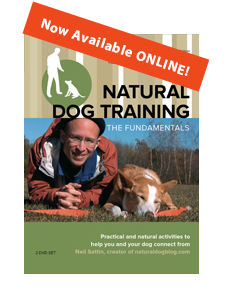
All of the techniques that I’ve mentioned to you (along with a lot more – for instance, channeling that high energy into really focused obedience) are also taught on my DVD set.  There’s a SUPER high energy hound/lab/mix dog (named Josie) on the DVDs, who’d be a great example for you.  You can check out the trailer for that here (scroll to the bottom):  Link to page about Natural Dog Training:  The Fundamentals

All my best, and please keep me posted on how it’s going.  Would you mind if I used your questions as a blog post?  I think it would be really helpful for other people to read.  I promise to keep you anonymous, of course!  And Happy Thanksgiving!

Then a GREAT follow-up from our reader:

Dear Neil –

Thank you so much for your thoughtful response! I will certainly get your CD [sic - it's a set of two DVDs] and try to learn from it also.

Just a lingering question though — for dogs to be good companions, there has to be some behaviors that are off limits. Like — nosing in our plants, munching on the dirt, and spreading it all over the floor.
To attempt dog psychology, I can see how this is all natural when she’s outside, so what’s the problem when she’s inside? It’s not hyper or aggressive behavior, just the  natural thing to do when you’re a hound and you use your nose ALL of the time (with my dog this means what goes into the nose goes into the mouth). I accept that we’ve been doing all the wrong things — but what are the right things to do in this specific instance?

Yes, of course you can use my questions as examples on your blog — and happy Thanksgiving!

Thanks again!

So what DO you do when you find your dog digging in the houseplants?

You’re most welcome, and I appreciate your willingness to get into dog mind.  Think of it as “dog heart”.

A question: how old do you think your dog is?  She sounds young, given your description.  A young dog especially needs to develop some inner structure around the question of “where do I get to deal with all this energy I’m experiencing?”

About your lingering question – and I think it gets to the root of “what drives behavior”.  You can look at “how we learn to behave” as a question of being praised for good things and punished for bad things – and hopefully we figure it out because we don’t want to be punished and we do want to be praised.  This model of psychology, however, only shows you part of what’s really going on.  And if you think of it in human terms, it’s easy to see why children raised like this might become either incredibly fearful (of making a mistake, for instance) or insecure (motivated by the desire to please others).

On the other hand, nurture what is unique in a being, nurture the part of them that yearns for, even demands expression – and THAT becomes (I believe) where their attention is focused.  For what’s at the core of our being is something good, creative, whole, and – I believe – social.  There are many speculative reasons for why dogs and humans have been linked up throughout history – but assuredly one of those reasons (which must have existed long before theories of behavior) is that a dog’s nature is somehow symbiotic with our own.  So the way that I train humans and people is meant to uncover what is simply at our core.  The closer that we are to “ourselves”, the more social and connected we can be.  For a human, that means connecting with your desire, your passion, and your presence, in the moment, on the planet.  For a dog, that means having an outlet for their emotional energy that satisfies them – and inserting you (their human) into that role.  So you can see the emotional dynamic at work within your dog in a way that’s free of human judgments.  Once you just recognize what “is”, and accept it, it frees you up to work with it, rather than fighting against it.

For the short term, you’re going to be developing a structure for your dog that reinforces, for her, that outside is where the energy moves and flows – through your interactions together.  And inside is where things are relaxed.  Massage.  Sleep.  Quiet time.  No talking, just touching.  Calming touch.  And when you’re not in a position to keep her out of the plants, she gets to go to a nice space (her crate) where’s she’s kept safe from her own curiosity.  Outside is where there’s lots to sniff, dig, and stimulate.  And the inside plants will certainly lose their appeal, as they become part of the inner landscape – just something to remind her of the relaxed state of being that being inside represents.  For that matter, if you (and whomever else is in the house) can work on keeping the indoor environment calm for yourselves (as well as your dog), it’ll cut down on the amount of stress that she feels the need to express indoors.

Let’s say, though, for the sake of your question, that you catch your dog with her nose in the plants.  What is she telling you in that moment?

“Give me something to do with my energy.”

So you could use a loud syllable (I use “Aye!”) to get her attention.  But at that point you need to give her something to DO.  Something positive.  Pull out a tug toy, let her have a tug on it and win the game.  Or grab a treat, call her name, and head off in the opposite direction so she has to come find you.

Since you’re in the house, you want to keep the play to a minimum, so once you’ve redirected her away from the plants, you might take some time to just sit with her and massage her, in order to relax her. The more relaxed your dog is, the more energy she’ll be able to experience without feeling the need to give it a voice.  When you’re in the house, the “problem” is generally one of not enough relaxation – with occasional times that you actually want to DO something to redirect energy (like when a guest arrives, or when, for whatever reason – like digging in the houseplants – she’s asking for your help).

I hope that makes sense to you!  Great question.


Did you find this article to be helpful? Would you like more information about how to transform your relationship with your dog (and your dog's relationship with the world)? Please subscribe to my e-mail newletter for quick tips, exclusive content, and...discounts on merchandise!

For Email Newsletters you can trust


Related Articles